

 La résurrection du Christ
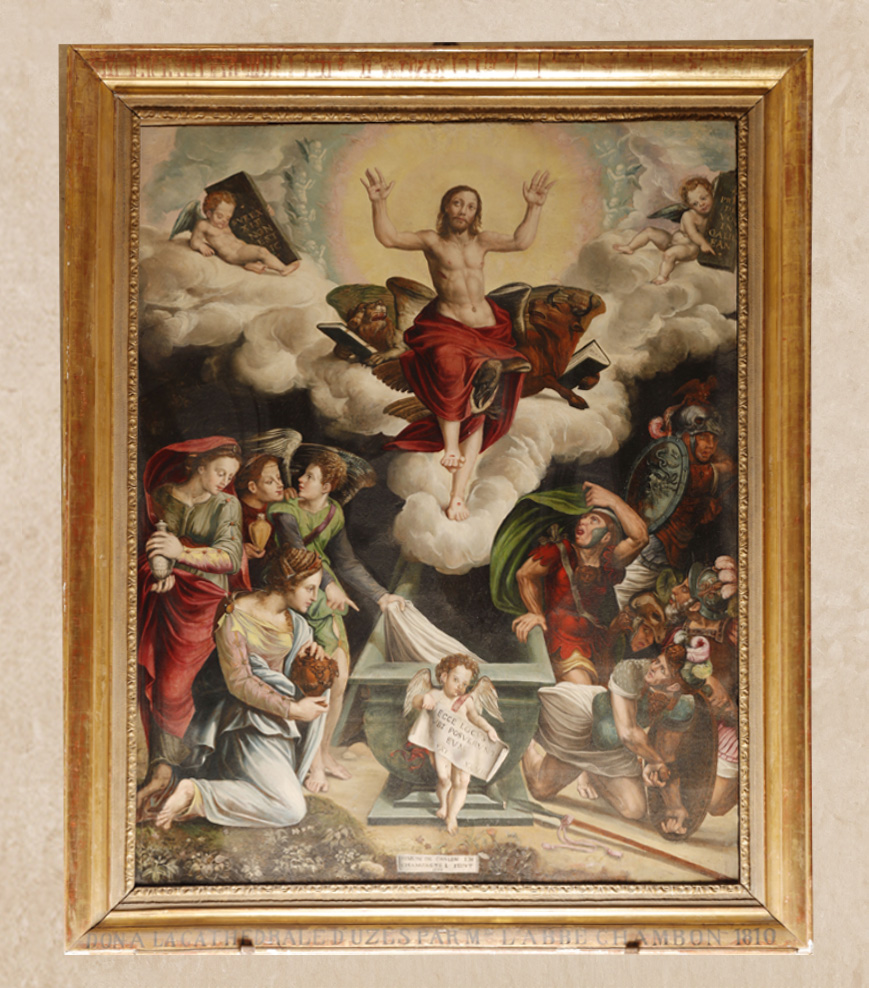
Peinture sur bois de 2,28m sur 1,82m.
Cette œuvre à été restaurée par Danièle Amoroso.
Deux inscriptions sont à remarquer. L’une sur le tableau :
SIMON DE CHALONS EN / CHAMPAGNE A PEINT / 1550.
L’autre sur le bord inférieur du cadre: DON A LA CATHÉDRALE D’UZÈS PAR M. L’ABBÉ CHAMBON 1810, prêtre missionnaire, à l’occasion de son départ pour la Louisiane en 1810. La fabrique entérine le don par délibération du 22 août 1810 (archives de la Fabrique, archives du diocèse de Nîmes).
Le peintre de ce tableau est Simon de Chalons, il a peint ce tableau en 1550.
Simon de Chalons est un artiste-peintre de la Renaissance d’origine Champenoise. Il fut actif à Avignon de 1532 à 1561 .
Le Christ ressuscité est au centre du tableau, il porte les stigmates de sa crucifixion. Il est positionné sur un nuage d’où il s’élève dans le ciel accompagné par trois évangélistes.
A gauche le lion représentant St Marc, à droite le taureau représentant St Luc et l’aigle représentant St Jean .
Les angelots placés en haut du tableau et devant le tombeau portent des inscriptions issues de l’évangile de Marc.
Les trois femmes à gauche sont amenées par un ange qui montre le tombeau vide. Elles semblent étonnées ou curieuses. Elles apportent les onguents pour embaumer le corps de Jésus.
A droite le groupe de soldats romains qui gardaient le tombeau sont effrayés ou stupéfaits.
Simon de Chalons est un des rares peintres actif en Provence au 16e siècle dont le nom nous ait été transmis. Synthèse entre les influences flamandes et italiennes, son art se rattache au courant du Mani
 The Resurrection of Christ
Painting on wood
measuring 2.28m by 1.82m
This artwork was restored by Danièle Amoroso.
Two inscriptions are to be noted: one on the painting: ‘Simon de Chalons in/Champagne painted/1550’, the other on the lower edge of the frame: ‘Donated to the Cathedral of Uzès by Abbé Chambon, 1810.’ The painter of this artwork is Simon de Chalons. He painted it in 1550. Simon is a Renaissance painter from Champagne. He was active in Avignon from 1532 to 1561.
The resurrected Christ is at the centre of the painting. He bears the stigmata of his crucifixion. Rising from a cloud, he ascends into the sky, accompanied by three evangelists. To the left, the lion represents Saint Mark; to the right, the bull represents Saint Luke; and the eagle represents Saint John. The cherubs at the top of the painting and in front of the tomb bear inscriptions from the Gospel of Mark.
The three women on the left are led by an angel pointing to the empty tomb. They look astonished or curious. They bring the ointments to anoint the body of Christ.
To the right, the group of Roman soldiers who were guarding the tomb are frightened or amazed.
Simon de Chalons is one of the few painters active in Provence in the 16th century whose name has been passed down to us.
Blending Flemish and Italian influences, his work belongs to the Mannerist movement.
 La risurrezione di Cristo
Pittura su legno di 2,28m per 1,82m.
Quest’opera è stata restaurata da Danièle Amoroso.
Due iscrizioni sono da notare. Una sul quadro: SIMON DE CHALONS EN/ CHAMPAGNE A PINT / 1550. L’altra sul bordo inferiore della cornice: DONAZIONE ALLA CATTEDRALE Dl UZÈS DA M. L’ABBÉ CHAMBON 1810.
Il pittore di questo quadro è Simon de Chalons, dipinse questo quadro nel 1550. Simon de Chalons è un pittore rinascimentale di origine Champenoise. Fu attivo ad Avignone dal 1532 al 1561.
li Cristo risorto è al centro del quadro, porta gli stigmi della sua crocifissione. È posizionato su una nuvola dove si alza nel cielo accompagnato da tre evangelisti. A sinistra il leone che rappresenta San Marco, a destra il toro che rappresenta San Luca e l’aquila che rappresenta San Giovanni. Gli angeli posti in cima al quadro e davanti alla tomba portano iscrizioni dal vangelo di Marco. Le tre donne a sinistra sono portate da un angelo che mostra la tomba vuota. Sembrano stupiti o curiosi. Portano gli unguenti per imbalsamare il corpo di Gesù.
A destra il gruppo di soldati romani che custodivano la tomba, sono spaventati o stupiti.
Simon de Chalons è uno dei pochi pittori attivi in Provenza nel XVI secolo di cui ci sia giunto il nome.
Sintesi di influenze fiamminghe e italiane, la sua arte si inserisce nel movimento manierista.
Tafelmalerei, 2,28 m × 1,82 m.
Dieses Werk wurde von Danièle Amoroso restauriert.
Zwei Inschriften sind besonders bemerkenswert:
Eine auf dem Gemälde: SIMON DE CHALONS EN / CHAMPAGNE A PEINT / 1550.
Die andere am unteren Rand des Rahmens: GESCHENK AN DIE KATHEDRALE VON UZÈS VON ABBÉ CHAMBON 1810, Missionspriester, anlässlich seiner Abreise nach Louisiana im Jahr 1810.
Das Kapitel bestätigte die Schenkung durch Beschluss vom 22. August 1810 (Archiv der Kathedrale, Archiv des Bistums Nîmes). Der Maler dieses Werkes ist Simon de Chalons, der das Gemälde im Jahr 1550 schuf.
Simon de Chalons war ein Renaissance-Maler aus der Champagne, der von 1532 bis 1561 in Avignon tätig war.
Der auferstandene Christus steht im Zentrum des Bildes. Er trägt die Wundmale der Kreuzigung und erhebt sich auf einer Wolke in den Himmel, begleitet von drei Evangelisten: links der Löwe als Symbol des heiligen Markus, rechts der Stier für den heiligen Lukas und der Adler für den heiligen Johannes.
Oben im Bild und vor dem leeren Grab tragen Putten Inschriften aus dem Markus-Evangelium.
Links führt ein Engel drei Frauen herbei, die erstaunt oder neugierig das leere Grab betrachten. Sie bringen Salben, um den Leib Jesu zu balsamieren.
Rechts sind römische Soldaten dargestellt, die das Grab bewachten und nun erschrocken oder fassungslos wirken.
Simon de Chalons ist einer der wenigen Maler, die im 16. Jahrhundert in der Provence tätig waren und deren Name überliefert ist.
Sein Werk verbindet flämische und italienische Einflüsse und gehört zum Stil des Manierismus.