
 Mobilier liturgique Goudji – 2024
Une création confiée au sculpteur Goudji
Né à Borjomi en Géorgie le 6 août 1941, Goudji étudie la sculpture à l’Académie des Beaux-Arts de Tbilissi de 1958 à 1962.
En 1962 il rejoint Moscou où il entame une carrière de sculpteur.
En 1969, il épouse Katherine Barsacq, dont le père travaille à l’Ambassade de France à Moscou puis s’établit en France en janvier 1974 grâce à l’intervention personnelle du Président Georges Pompidou.
Il obtient la nationalité française en 1978.
Son art est novateur : sculpteur de formation, il ne crée que des pièces uniques. Orfèvre de métier, il travaille les métaux précieux en conjuguant la technique de la dinanderie avec l’incrustation de pierres dures dans le métal, une innovation dont il est à l’origine.
Très tôt reconnu, il est sollicité en 1976 pour créer l’épée d’académicien de Félicien Marceau… Depuis lors, Goudji réalisera un grand nombre de bijoux et d’objets précieux dont quatorze épées d’académicien dont celles d’Hélène
Carrère d’Encausse, Raymond Barre et Maurice Allais ou encore le marteau du commissaire-priseur Philippe Rouillac.
Ses œuvres font l’objet de grandes expositions en France et à l’étranger (musée des arts décoratifs de Paris ; musée du château de Blois, les musées du Vatican…).
Ses œuvres singulières sont également souvent offertes par les Présidents de la République aux chefs d’État étrangers.
En 1985, il crée une cuve baptismale et un chandelier pascal pour l’exposition du Comité National d’Art Sacré, à l’abbaye de l’Épau. Cette œuvre déposée en 1986 à la Cathédrale Notre-Dame de Paris réussit à renouveler le matériel liturgique tout en l’inscrivant dans la tradition…
De l’objet, Goudji passe naturellement au sanctuaire, rejoignant la préoccupation des grands architectes qui désirent que tout soit en harmonie, le mobilier et l’immobilier. Chaque pièce exprime une pensée théologique par les matériaux, les pierres, les couleurs et le bestiaire revisité par l’orient caucasien.
Entre 1992 et 1996, il conçoit vingt-cinq pièces, dont le Maître-Autel, pour la Cathédrale Notre-Dame de Chartres, toutes inscrites à l’Inventaire du Patrimoine. En 2008, il crée vingt-cinq nouvelles œuvres (vases sacrés, chandeliers, ciboires), qui font de la collection chartraine, l’une des plus importantes collections d’œuvres liturgiques de Goudji en France.
Parmi les sanctuaires emblématiques réaménagés par Goudji, il y a notamment la cathédrale de Luçon (1995), l’abbaye de Tournus (1999), la grande Trappe de Soligny (2000), Fribourg en Suisse (2004), la Basilique Sainte-Clotilde (2007) à Paris, la basilique Notre-Dame-du-Rosaire de Lourdes (2012).
En 1999 il crée et offre au Pape Jean-Paul II, le reliquaire de Padre Pio à l’occasion de sa béatification. Il réalisera aussi le marteau d’ouverture de la Porte Sainte de St Pierre de Rome pour son ouverture par le Pape Jean-Paul II.
Ce mobilier est la toute dernière contribution des paroissiens d’Uzès à la vie de leur paroisse et manifeste leur attachement à leur cathédrale.
Le mobilier a été consacré et baptisé le 1er juin 2024 par Monseigneur Nicolas Brouwet, évêque de Nîmes.
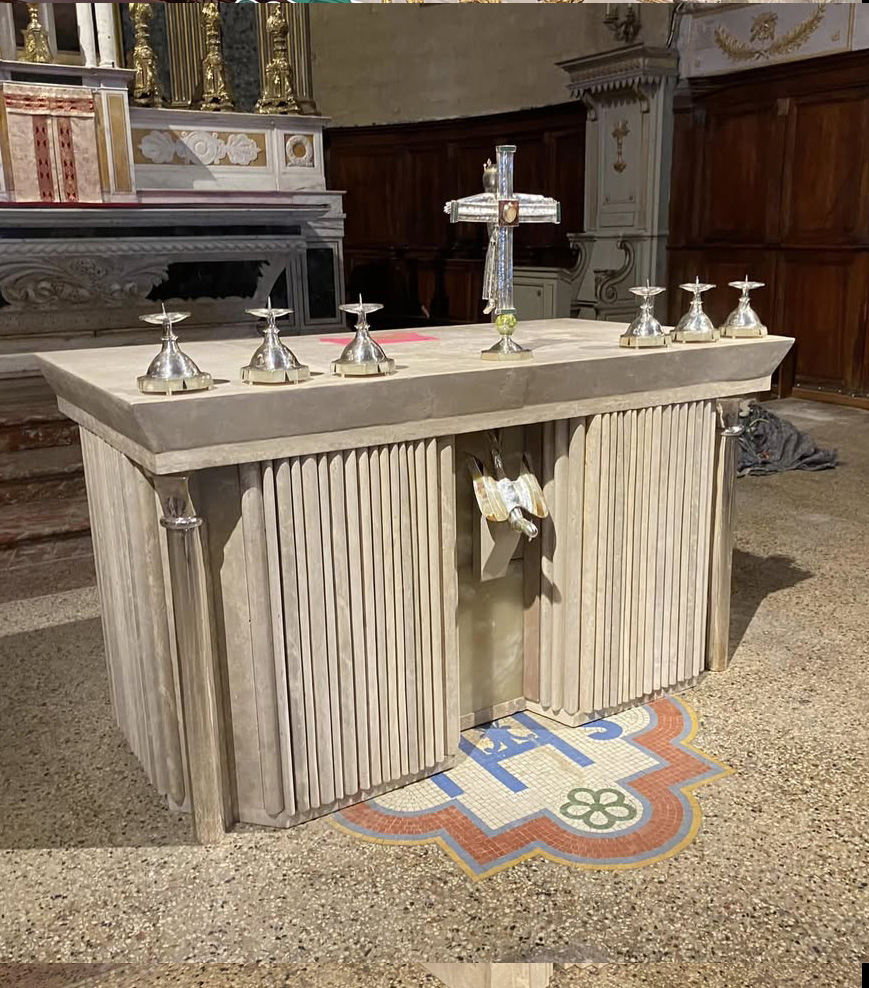
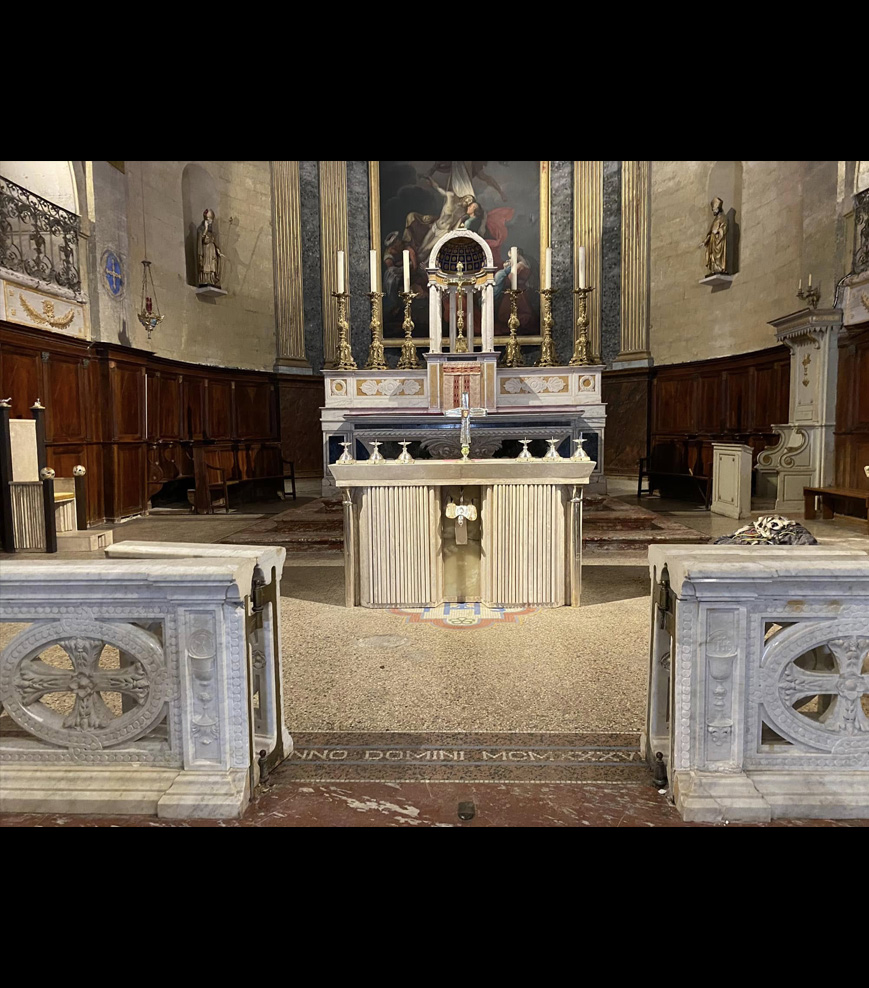
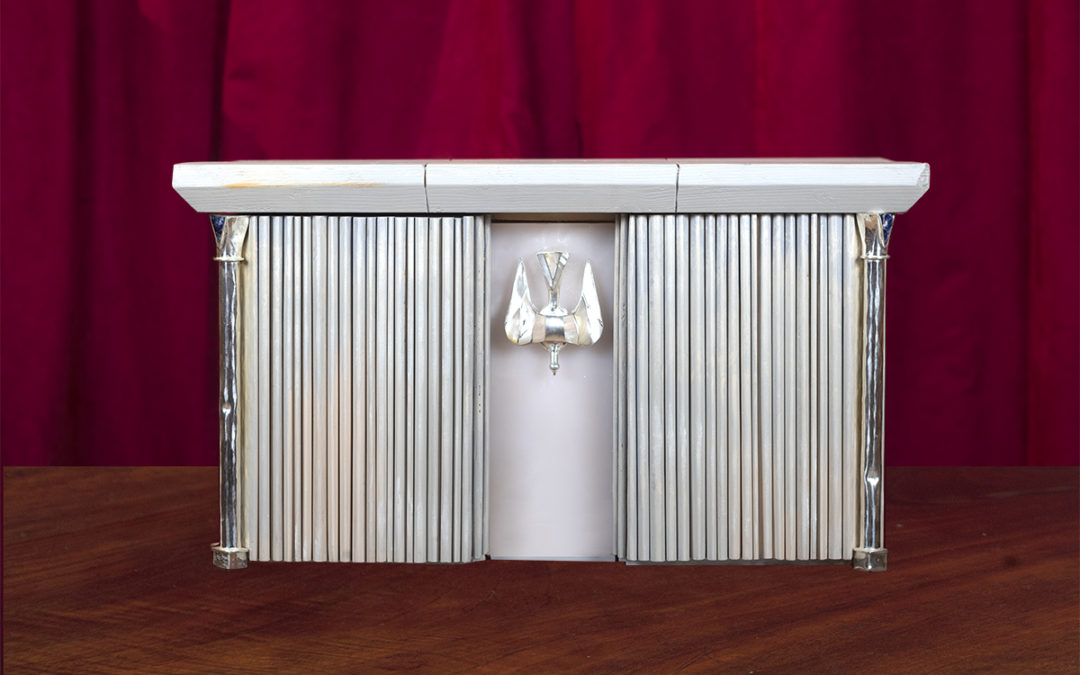
Maître-Autel
H 105 x L 180 x l 103 cm
Matériau : pierre calcaire dur de Pontijou, dans la région de Blois, qui représente le drapé des tuniques du Christ et des ses apôtres.
Ce drapé fait également penser aux tuyaux de l’orgue qui se trouve à l’entrée de l’église.
Aux quatre coins de l‘autel, une colonne en argent dont le chapiteau est pavé d’onyx. Ces quatre colonnes représentent les quatre apôtres, piliers de l’église chrétienne.
Sur la façade une colombe eucharistique en argent représentant le Saint-Esprit. Elle est pavée d’onyx et d’amphibolite.
Sur le plateau de l’autel une niche dans laquelle sont enchâssés les reliques de St Pierre…
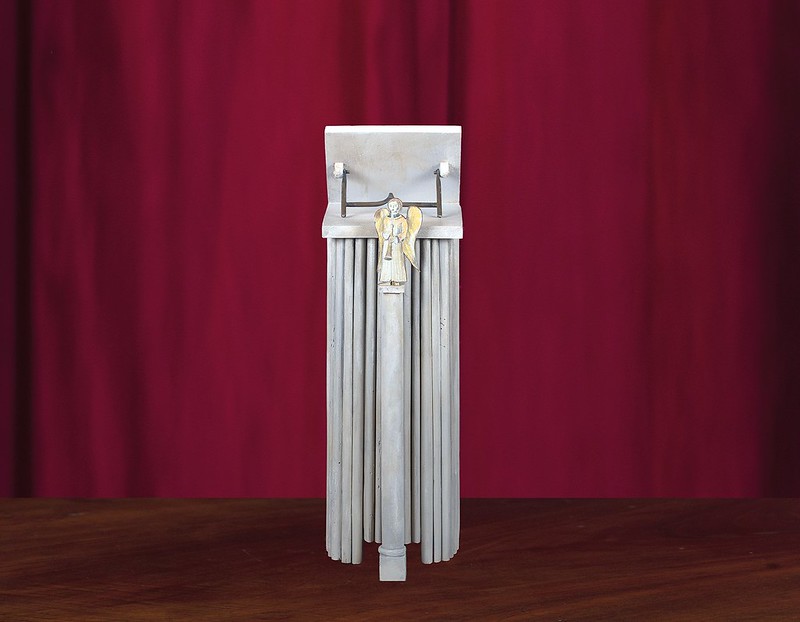
L’Ambon, lieu de la parole
H 140 x L 57 x l 50 cm
Matériau : pierre calcaire dur de Pontijou qui représente le drapé des tuniques du Christ et de ses apôtres, onyx, lapis-lazuli et jaspe.
Sur la façade, une statue en argent représente l’ange musicien de l’Apocalypse de Saint-Jean.
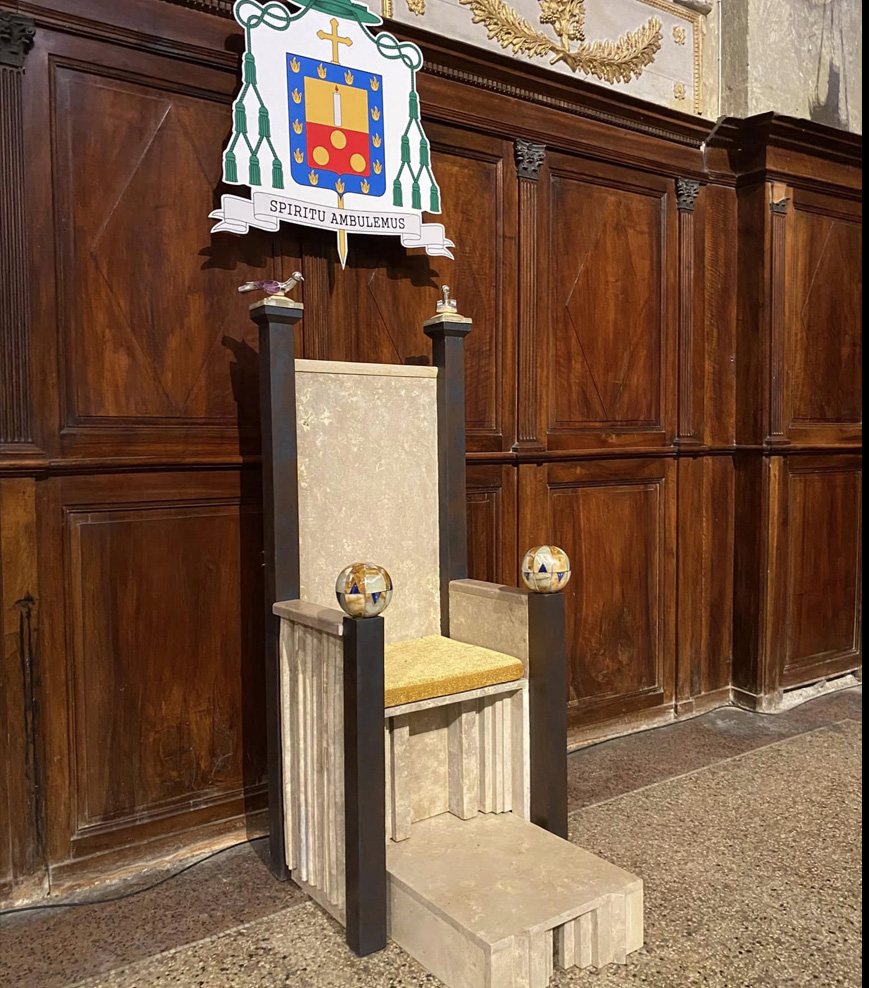
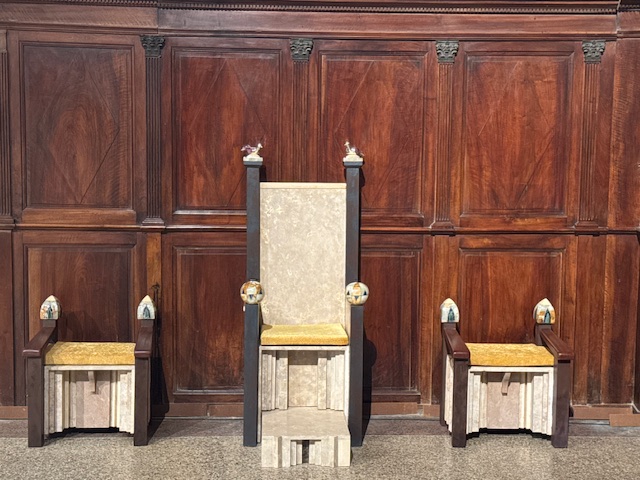
Le siège de Présidence
H 160 x L 66 x l 50 cm
Matériaux : pierre calcaire dur de Pontijou et bois de châtaignier teinté en rouille d’acier.
Au sommet, deux Phénix, symbole de l’Immortalité.
Au bout des accoudoirs deux sphères symbolisant les yeux du Créateur comme dans le célèbre tableau de Nicolas Poussin « Lazare et Rebecca »
Sous le fauteuil de Présidence, un degré pour l’élévation vers ce siège.
Les sièges des assistants
H 76 x L 67 x P 52 cm
Matériaux : pierre calcaire dur de Pontijou, bois de châtaignier et acajou.
De chaque côté du dossier deux prismes triangulaires en sodalite, onyx et serpentine.
6 chandeliers d’autel
En argent et onyx
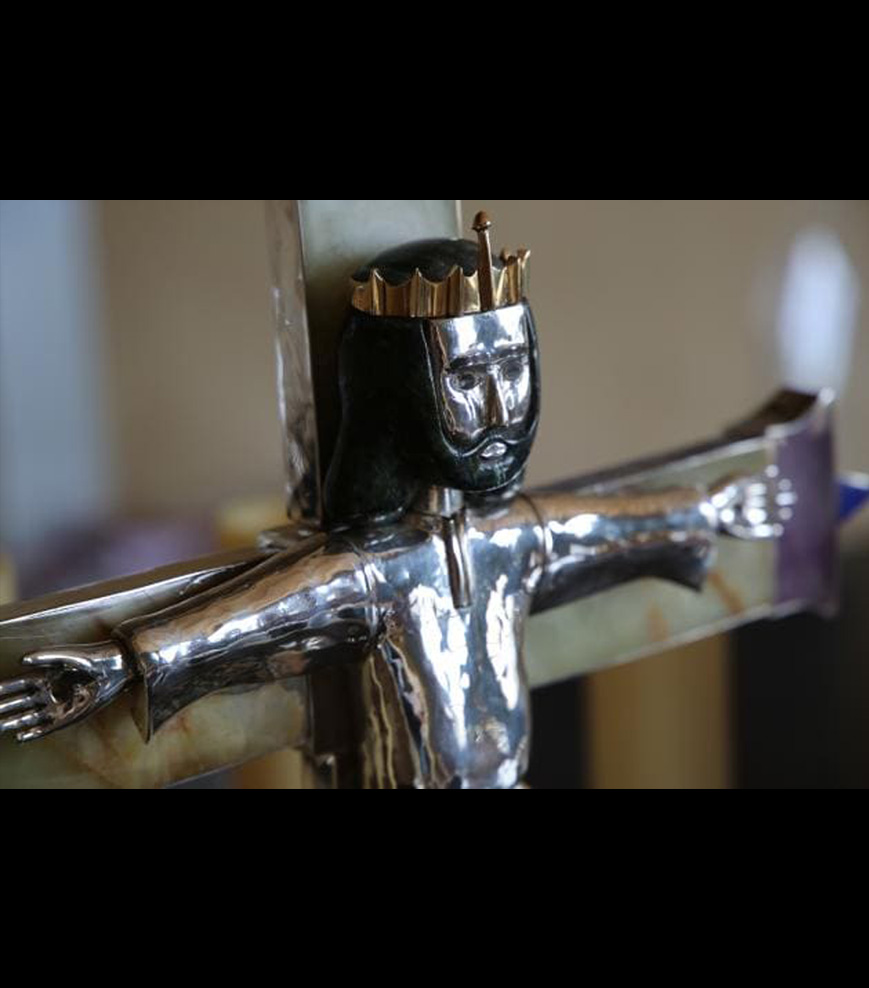
Une croix d’autel
En argent, serpentine et jaspe
Elle représente le Christ en gloire, le Christ ressuscité.
 Goudji liturgical furniture – 2024
Liturgical Furniture by Goudji – 2024
A creation entrusted to the sculptor Goudji
Born in Borjomi, Georgia, on August 6, 1941, Goudji studied sculpture at the Academy of Fine Arts in Tbilisi from 1958 to 1962.
In 1962, he moved to Moscow and began a career as a sculptor.
In 1969, he married Katherine Barsacq, whose father worked at the French Embassy in Moscow. Thanks to the personal intervention of President Georges Pompidou, he settled in France in January 1974.
He obtained French nationality in 1978.
Goudji’s art is innovative: trained as a sculptor, he creates only unique pieces. As a goldsmith, he works with precious metals, combining metalworking techniques with the inlay of hard stones—a technique he pioneered.
Highly recognized, he was commissioned in 1976 to create the academician’s sword for Félicien Marceau. Since then, Goudji has produced many jewels and precious objects, including fourteen academicians’ swords—among them those of Hélène Carrère d’Encausse, Raymond Barre, and Maurice Allais—as well as the auctioneer’s hammer of Philippe Rouillac.
His works have been displayed in major exhibitions in France and abroad (Museum of Decorative Arts in Paris, Château de Blois, the Vatican Museums…).
His exceptional works are often presented by French Presidents to foreign heads of state.
In 1985, he created a baptismal font and Paschal candlestick for the National Committee for Sacred Art, at the Abbaye de l’Épau. These were deposited in 1986 in Notre-Dame Cathedral in Paris, renewing liturgical furniture while anchoring it in tradition.
From objects, Goudji naturally turned to sanctuaries, sharing the vision of great architects who seek harmony between furniture and architecture. Each piece expresses theological meaning through materials, stones, colors, and a bestiary reinterpreted through a Caucasian lens.
Between 1992 and 1996, he created twenty-five pieces—including the high altar—for Chartres Cathedral. All are now listed as heritage works. In 2008, he produced twenty-five new pieces (sacred vases, candlesticks, ciboria), making the Chartres collection one of the most significant ensembles of Goudji’s liturgical works in France.
Notable sanctuaries redesigned by Goudji include the Cathedral of Luçon (1995), the Abbey of Tournus (1999), the Grande Trappe of Soligny (2000), Fribourg in Switzerland (2004), Sainte-Clotilde Basilica in Paris (2007), and the Basilica of Our Lady of the Rosary in Lourdes (2012).
In 1999, he created and offered to Pope John Paul II the reliquary of Padre Pio for his beatification. He also made the hammer for opening the Holy Door of Saint Peter’s Basilica, used by Pope John Paul II.
This furniture is the latest contribution from the parishioners of Uzès to the life of their parish, expressing their deep attachment to their cathedral.
It was consecrated and blessed on June 1, 2024, by Bishop Nicolas Brouwet of Nîmes.
High Altar
H 105 x W 180 x D 103 cm
Material: Hard Pontijou limestone from the Blois region, evoking the drapery of Christ’s and the apostles’ tunics.
The folds also recall the organ pipes at the entrance of the church.
At each corner of the altar, a silver column with an onyx-inlaid capital—symbolizing the four apostles, pillars of the Christian Church.
On the front: a Eucharistic dove in silver representing the Holy Spirit, inlaid with onyx and amphibolite.
The altar top contains a niche with relics of Saint Peter…
The Ambo (Place of the Word)
H 140 x W 57 x D 50 cm
Material: Hard Pontijou limestone evoking the drapery of Christ and the apostles’ tunics, with onyx, lapis lazuli, and jasper.
On the front: a silver statue of the angel musician from Saint John’s Apocalypse.
Presider’s Chair
H 160 x W 66 x D 50 cm
Materials: Hard Pontijou limestone and chestnut wood stained in iron rust.
At the top: two phoenixes, symbols of immortality.
At the ends of the armrests: two spheres representing the eyes of the Creator, like in Nicolas Poussin’s famous painting Lazarus and Rebecca.
Beneath the chair: a step symbolizing the elevation to this seat.
Assistants’ Chairs
H 76 x W 67 x D 52 cm
Materials: Hard Pontijou limestone, chestnut, and mahogany.
On each side of the backrest: triangular prisms made of sodalite, onyx, and serpentine.
Six Altar Candlesticks
Made of silver and onyx
One Altar Cross
Made of silver, serpentine, and jasper
It represents Christ in Glory, the Risen Christ.
 Arredo liturgico Goudji- 2024
Arredi liturgici di Goudji – 2024
Una creazione affidata allo scultore Goudji
Nato a Borjomi, in Georgia, il 6 agosto 1941, Goudji ha studiato scultura all’Accademia di Belle Arti di Tbilisi dal 1958 al 1962.
Nel 1962 si è trasferito a Mosca, dove ha iniziato la carriera di scultore.
Nel 1969 ha sposato Katherine Barsacq, figlia di un funzionario dell’Ambasciata di Francia a Mosca. Grazie all’intervento personale del Presidente Georges Pompidou, si è stabilito in Francia nel gennaio 1974.
Ha ottenuto la cittadinanza francese nel 1978.
L’arte di Goudji è innovativa: formatosi come scultore, crea solo pezzi unici. Orafo di mestiere, lavora metalli preziosi unendo la tecnica della dinanderia all’intarsio di pietre dure nel metallo, una tecnica che ha inventato lui stesso.
Riconosciuto molto presto, nel 1976 è stato incaricato di creare la spada d’accademico per Félicien Marceau. Da allora, Goudji ha realizzato numerosi gioielli e oggetti preziosi, tra cui quattordici spade d’accademico (come quelle di Hélène Carrère d’Encausse, Raymond Barre, Maurice Allais) e il martello del banditore Philippe Rouillac.
Le sue opere sono state esposte in importanti mostre in Francia e all’estero (Museo delle Arti Decorative di Parigi, Castello di Blois, Musei Vaticani…).
Molte delle sue creazioni sono state offerte dai Presidenti della Repubblica francese a capi di Stato stranieri.
Nel 1985 ha creato una fonte battesimale e un cero pasquale per una mostra del Comitato Nazionale per l’Arte Sacra, all’abbazia dell’Épau. Queste opere, installate nel 1986 nella Cattedrale di Notre-Dame di Parigi, sono riuscite a rinnovare l’arredo liturgico pur mantenendolo ancorato alla tradizione.
Dall’oggetto liturgico, Goudji è passato naturalmente all’intero spazio sacro, condividendo la visione degli architetti che desiderano un’armonia tra mobili e architettura. Ogni pezzo esprime un pensiero teologico attraverso i materiali, le pietre, i colori e una rivisitazione del bestiario ispirata all’Oriente caucasico.
Tra il 1992 e il 1996 ha progettato venticinque pezzi, tra cui l’Altare Maggiore, per la Cattedrale di Chartres, oggi iscritti nell’Inventario dei Beni Culturali. Nel 2008 ha creato venticinque nuove opere (vasi sacri, candelabri, pissidi), rendendo quella di Chartres una delle più importanti collezioni di opere liturgiche di Goudji in Francia.
Tra i santuari rinnovati da Goudji si ricordano: la Cattedrale di Luçon (1995), l’Abbazia di Tournus (1999), la Grande Trappa di Soligny (2000), Friburgo in Svizzera (2004), la Basilica di Santa Clotilde a Parigi (2007), e la Basilica di Nostra Signora del Rosario a Lourdes (2012).
Nel 1999 ha creato e donato a Papa Giovanni Paolo II il reliquiario di Padre Pio in occasione della beatificazione. Ha inoltre realizzato il martello per l’apertura della Porta Santa nella Basilica di San Pietro.
Questi arredi rappresentano l’ultimo contributo dei parrocchiani di Uzès alla vita della loro parrocchia, testimoniando il loro attaccamento alla cattedrale.
Sono stati consacrati e benedetti il 1° giugno 2024 da Monsignor Nicolas Brouwet, vescovo di Nîmes.
Altare Maggiore
H 105 x L 180 x P 103 cm
Materiale: Pietra calcarea dura di Pontijou, della regione di Blois, che evoca le pieghe delle tuniche di Cristo e degli apostoli.
Queste pieghe richiamano anche le canne dell’organo situato all’ingresso della chiesa.
Ai quattro angoli dell’altare: una colonna d’argento con capitello incastonato di onice. Le quattro colonne rappresentano i quattro apostoli, pilastri della Chiesa.
Sulla facciata: una colomba eucaristica in argento che rappresenta lo Spirito Santo, incastonata di onice e anfibolite.
Sul piano dell’altare: una nicchia che custodisce le reliquie di San Pietro…
L’Ambone – Luogo della Parola
H 140 x L 57 x P 50 cm
Materiali: Pietra calcarea dura di Pontijou, onice, lapislazzuli e diaspro
Sulla facciata: una statua d’argento raffigura l’angelo musicista dell’Apocalisse di San Giovanni.
Cattedra del Celebrante
H 160 x L 66 x P 50 cm
Materiali: Pietra calcarea dura di Pontijou e legno di castagno tinto color ruggine
In cima: due Fenici, simbolo di immortalità
Alla fine dei braccioli: due sfere che simboleggiano gli occhi del Creatore, come nel famoso dipinto Lazzaro e Rebecca di Nicolas Poussin
Sotto la cattedra: un gradino, simbolo dell’elevazione verso questo posto.
Sedie degli Assistenti
H 76 x L 67 x P 52 cm
Materiali: Pietra calcarea dura di Pontijou, legno di castagno e mogano
Su ciascun lato dello schienale: due prismi triangolari in sodalite, onice e serpentino
6 candelabri da altare
In argento e onice
1 croce da altare
In argento, serpentino e diaspro
Rappresenta il Cristo nella gloria, il Cristo risorto.
 Liturgisches Mobiliar von Goudji – 2024